On Tuesday 22 September, Anthropic launched Claude Opus 5.5. It's only two months since Opus 5 arrived, and we expected a small update. The changes are bigger than that. Opus 5.5 is the first model in the new 5.5 family, with Sonnet 5.5 and Haiku 5.5 due over the coming weeks.
How we've worked so far
At Raunic, we've split our work across several models. Opus 5 and Sonnet have written most of our code, including in Raunic OS, the system we use to handle enquiries, leads and projects. We've brought in Fable when we need the most reasoning power, such as when planning architecture and reviewing code before it goes into production.
That split has worked well. But Fable is a larger, heavier model, so we've been careful about when we use it.
On par with Fable, at a lower price
More interesting than Opus 5.5 beating Opus 5 is that it also beats Fable 5.1 in several areas. According to Anthropic, it leads on agentic coding, knowledge work and computer use. Anthropic itself stresses that it's on par with Fable 5.1 on most things, and that small differences in benchmark results say less than they used to.
Some numbers from the launch:
- On Terminal-Bench 4.0, which measures coding in the terminal, Opus 5.5 scores 66.4 percent at extra high. Fable 5.1 scores 55.8 and Opus 5 scores 52.3.
- On GDPval-AA, which measures knowledge work, it reaches 1846 Elo at max, versus 1735 for Fable 5.1 and 1708 for Opus 5.
- GitHub, which tested the model in VS Code, reports that it solved more terminal tasks than Opus 5 in fewer than half as many steps.
Benchmarks don't tell the whole story. But fewer steps per task is something you notice day to day, both in time and on the invoice.
Cheaper and faster
The price has come down:
- input per million tokens (was $5)
- $4
- output per million tokens (was $25)
- $20
- cache reads per million tokens (was $0.50)
- $0.20
- cheaper than Opus 5 on typical workloads, according to Anthropic
- ~40%
Anthropic estimates that typical workloads will be around 40 percent cheaper to run than on Opus 5, with the default settings. The model also writes its responses more than 30 percent faster. For our clients, that means the AI solutions we build become cheaper to operate.
You'll notice it on a subscription too
You don't need to pay per token to notice the difference. We use Claude Max ourselves, where you don't pay per token but have a fixed allowance that fills up over the week – a bucket, of sorts. Because Opus 5.5 uses fewer tokens per task, and medium is now the default, the bucket lasts longer.

When this article was written, we had used 84 percent of the weekly allowance on Max 20x. With Opus 5 at high, we're fairly sure we would already have hit the ceiling. Fable also has its own weekly allowance, so the more planning and code review Opus 5.5 can take on, the more Fable capacity we have left for the tasks that really need it.
Medium is often enough
With Opus 5.5, you choose how much the model should think before it answers: low, medium, high, extra high or max. The higher you go, the more thorough the answer, but it also costs more tokens and takes longer.
On Opus 5, high was the default. Anthropic has now moved the default down to medium, and for good reason. According to Anthropic's own tests, Opus 5.5 at medium is at least as good as Opus 5 at high, for both coding and knowledge work. On several coding tasks, low gets almost as far, at a much lower price.
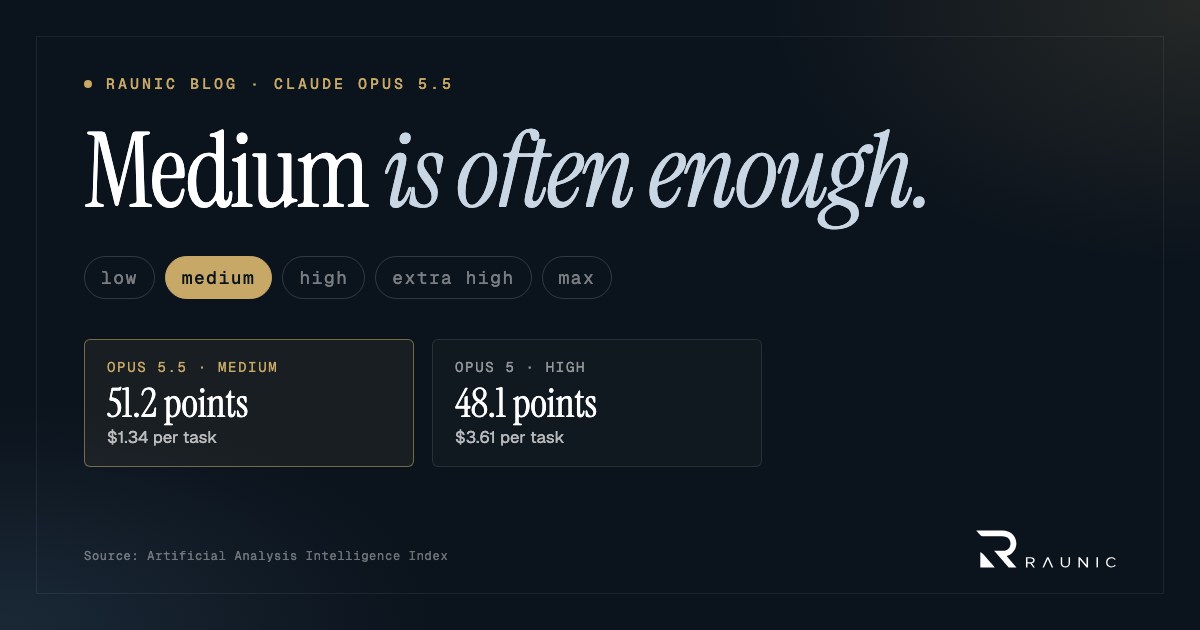
Numbers from the independent Artificial Analysis index point the same way. There, Opus 5.5 at medium scored 51.2 points, versus 48.1 for Opus 5 at high. Each task cost $1.34 versus $3.61. Turning it all the way up to max gave around seven more points, but cost more than four times as much.
So we're no longer turning things up to max out of habit. Medium is our starting point. We use high for the hardest problems, and save extra high and max for long, demanding tasks where we actually see a better result. Anthropic also recommends testing this on your own tasks rather than carrying over settings from the previous model. That's what we're doing.
Writes more like a person
Anthropic says Opus 5.5 puts the most important thing first, uses less jargon and follows the writing rules you give it. We have fixed rules for how our text should read, and a model that follows them without being reminded saves us a lot of rework.
Safer where it matters
Opus 5.5 is better at resisting so-called prompt injection: when someone hides instructions in an email or document to trick the AI into doing something it shouldn't. When AI reads enquiries from unknown senders, this matters. In a new Anthropic test, Opus 5.5 attempted to break out of the boundaries it was meant to stay within around 85 percent less often than Opus 5.
The model has safeguards on par with Fable 5.1, and Anthropic writes that it has watermarking to meet the requirements of the EU AI Act. For us, the same principle applies as before: AI suggests, people decide.
Other news
- The model always thinks. Opus 5.5 decides for itself how much to think, and that can't be turned off. You steer it with the setting above. Anthropic suggests removing old tricks like "think carefully before you answer" from your instructions.
- Clearer along the way. On longer tasks, the model tells you what it has done, what it has found and what it needs from you. That makes it easier to follow along when it works independently.
- Reads charts better. Even at the lowest setting, Opus 5.5 reads densely packed charts more accurately than Opus 5 did at the highest. Useful for screenshots and PDF reports.
- Fast mode. For those who need answers quickly, there is now a fast mode in the API and Claude Code that is up to 2.5 times faster. It's in preview and costs twice as much.
- More usage in subscriptions. The five-hour limits have been raised for Pro, Max, Team and Enterprise.
If you build on the API, there are a few changes to note before switching models. Thinking can't be turned off, and you can no longer force the model to use a specific tool. Existing integrations that do this will get an error. In beta, you can also add tools mid-conversation without losing the cache, and decide yourself when long conversations should be compacted.
What we're doing now
- Opus 5.5 becomes our main model for development in Claude Code.
- We use medium as the default, and test low and high against it. Low is particularly interesting for high-volume solutions.
- We're testing whether Opus 5.5 can take over much of the planning and code review we've used Fable for. We'll keep Fable where we want an extra pass.
- When Sonnet 5.5 arrives, we'll test it on simpler tasks.
- We're reviewing the solutions we run for clients to see where we can switch models and bring costs down.
We're happy to share what we learn along the way. If you're wondering what this could mean for your business, just get in touch.