On Monday 9 November, Claude Fable 5.2 was released. On Tuesday evening we started a project to test it on something that takes more than code: taste, feeling, image, sound and publishing. The goal was never to become a record label. The goal was to learn how the newest models actually work across a whole project, from idea to published.
Why a folk duo?
We learn best by building. A course tells you what a model can do. A real project shows you where it stops, what takes time, and what a human still has to do.
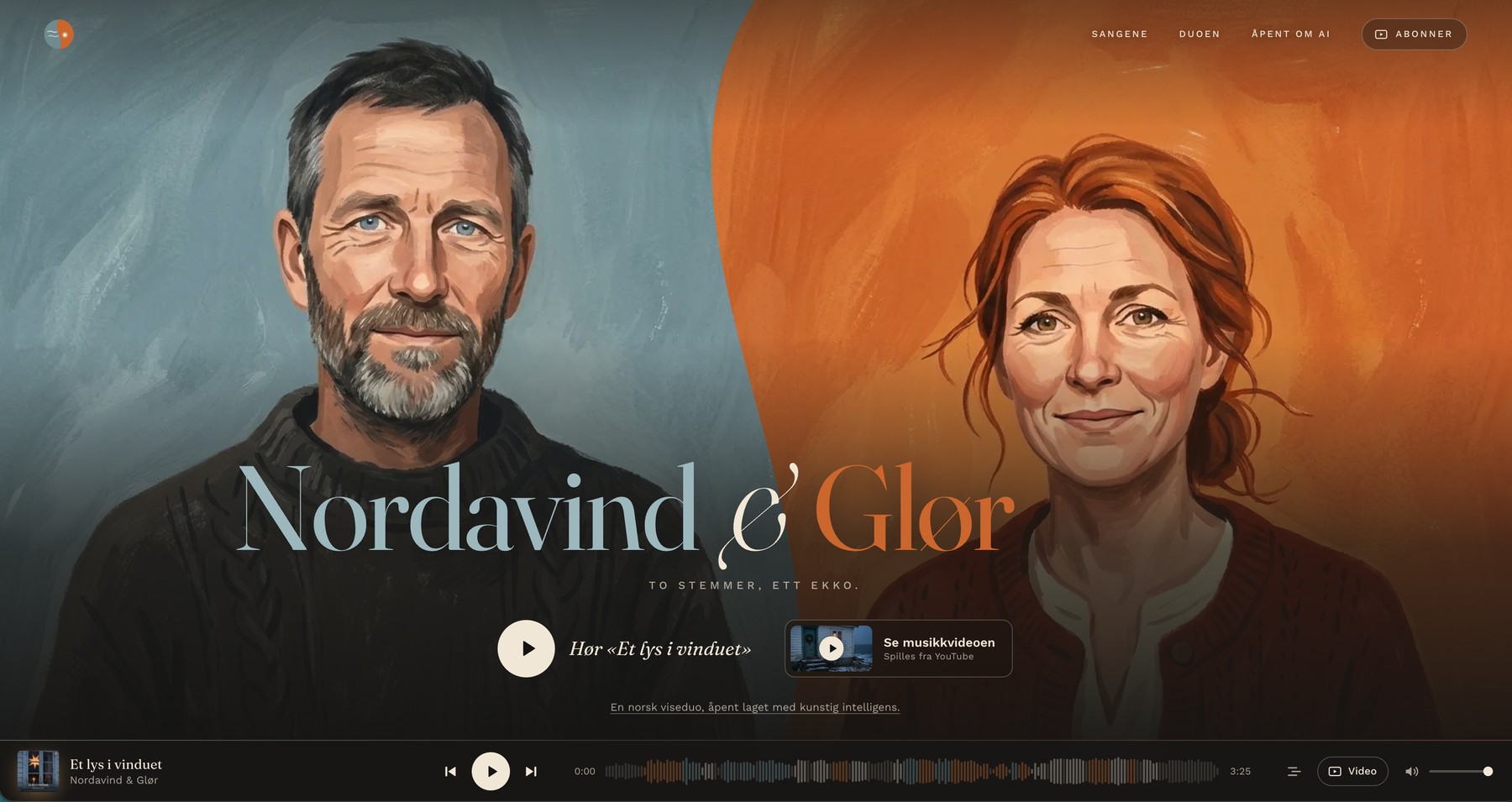
The result is called Nordavind & Glør, which means North Wind and Embers. Two voices, one echo. He is cool and calm, she is warm. The music is Norwegian folk song, a tradition known as vise, and the direction is melancholy and feeling. For the record: this is not exactly our own taste in music, and that was part of the point.
What was made
From Tuesday evening to Friday morning, this was finished and published:
- Two songs: the Christmas song “Et lys i vinduet” (A light in the window) and “Det er deg vi kommer fra” (You are where we come from). The lyrics were written together with Claude, the music was made in Suno.
- Two full-length music videos. Stills and clips from Google Flow, lip sync from Hedra, and editing with ffmpeg directed by Claude.
- Short vertical clips, subtitles and thumbnails, made by Claude with our own scripts.
- Name, logo, colours and typeface.
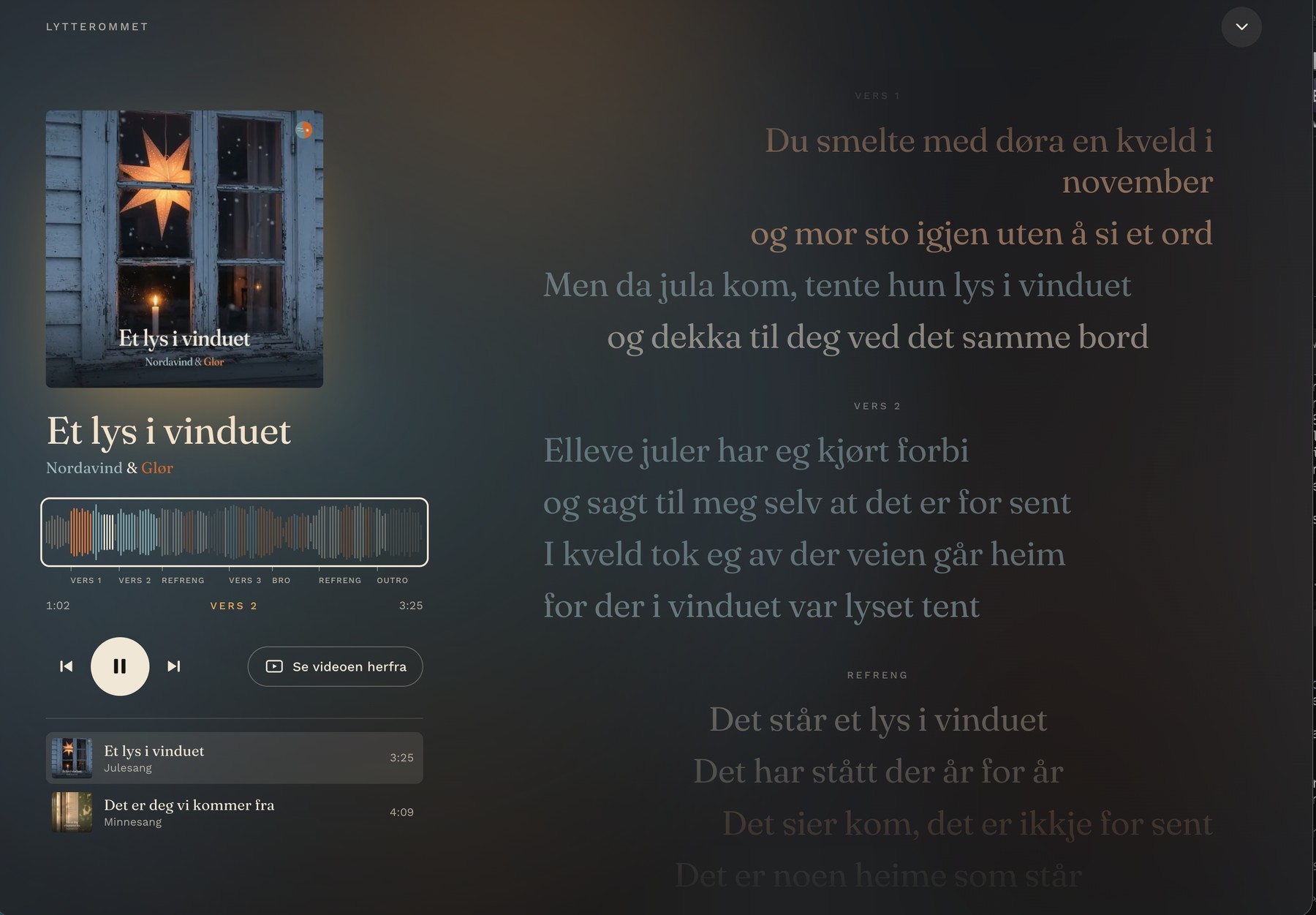
- The artist site nordavindogglor.no, built in Claude Code with Fable 5.2.
Claude has been director, editor and project manager throughout. We made the decisions, listened and said no.
Five things we learned about how to work
1. The human is the ear and the eye. The model cannot hear. Who sings which line, whether the lyrics are in sync, and whether a transition feels right were things we had to confirm ourselves. Suno, for example, did not always follow the tags for who should sing. That cost us a lip sync we had to throw away, because the wrong person was singing on screen.
2. The viewer should not be hunting for errors. That became our quality rule. A cardigan on the wall that suddenly moves its sleeve. A door that flaps. A curtain on only one side of the window. Every detail like that was replaced. This is where the time goes, not in the generation itself.
3. Learn the limits of the tools early. The style words in Suno steer more than the lyrics do. Flow loses reference images between rounds, so characters have to be built on from an approved image. None of this is in a manual. We wrote it down as we went, and the next song went noticeably faster.
4. Write everything down in the project folder. Lyrics, timestamps, shot plan, mistakes and decisions are all plain files. That lets a new session, or a completely different tool, take over without anything having to be explained again. This is what made the website possible in a morning.
5. Kill things. Song number three was meant to be a party song. It came out as shouty graduation-party music, and we shelved it the same evening. Testing fast is only useful if you also discard fast.
The most impressive part: an artist site in a morning
On Friday morning we gave Claude Code the project folder and one brief: build an artist site we are proud of. About two hours later, nordavindogglor.no was live on its own domain.
- the whole session on the clock, including breaks
- 3 h 8 min
- time the model was actually working
- under 45 min
- cost at full API price
- $37.56
- lines of code, with no framework and no server
- approx. 2,700
Figures from Claude Code for the whole session. The cost is what the session would have cost at list price. For us it was covered by the subscription.
Those three hours were not three hours of work either. In the same period we walked the dog, sat in a Teams meeting, took phone calls and wrote code for client projects. The website was made alongside an ordinary working day.
What impressed us was not the speed but the choices. The model asked six questions, proposed three concepts and recommended one, with reasons. The site is built around the idea that the light follows the voice: cool from the left when he sings, warm from the right when she sings. Press “Se videoen” (watch the video) in the middle of a song and the music video starts at the same second. The subtitle files we had already made for YouTube became live lyrics in the player.
Three things in the brief made the most difference:
- We asked for something bold that could be toned down, rather than something safe.
- Concepts first, building afterwards.
- The model had to look at the result in the browser itself, and always say what it had checked and what it had not.
It was not flawless. At one point the site erased itself a few seconds after the music started, because two things had been given the same name in the code. The model found the bug by testing and fixed it. And for a while the computer played a Christmas song without us being able to find where the sound came from. It was the test browser that nobody had stopped.
Social media: a cold-start experiment
The duo is also a measuring station. The question is simple: can a brand-new account, openly made with AI, get views purely through the platforms' own recommendations?
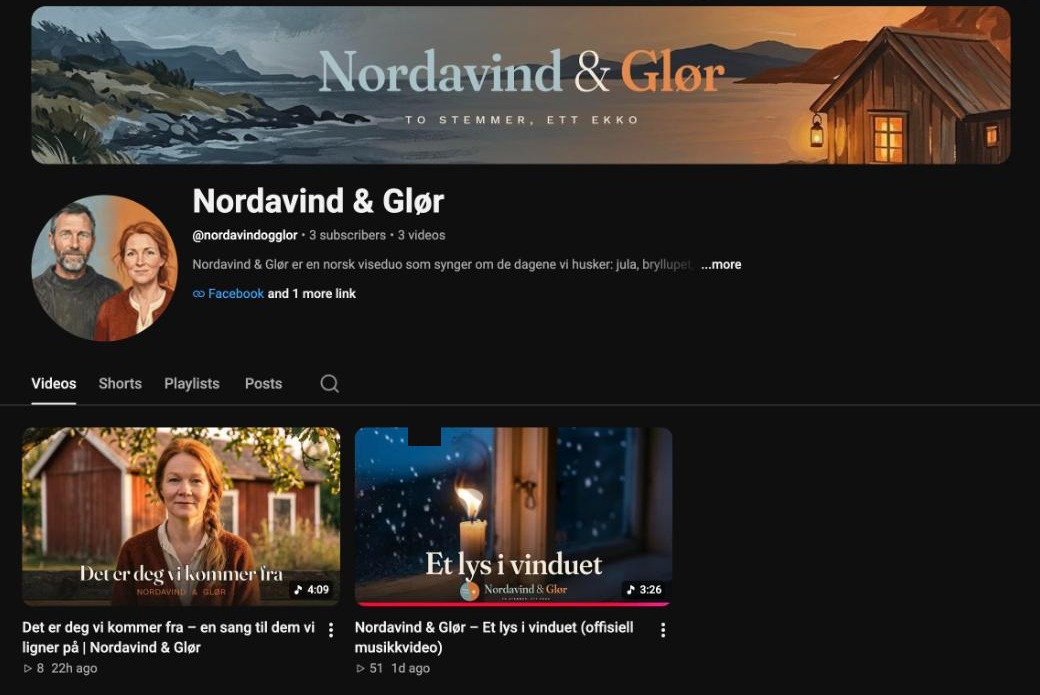
The rules for the first days were no sharing from personal profiles, no ads and the same clip on every platform. The hypothesis is that long videos on a new channel are barely shown, while short vertical clips are tested on strangers regardless of follower count.
It is too early for conclusions, but we already have some observations:
- Shared posts reach few people. A personal share of the music video on Facebook got 326 views and 5 reactions in 16 hours. That is low for that profile. We do not know whether the reason is that the post was shared rather than uploaded directly, that the opening line was too technical, or the AI label.
- You have to switch on AI labelling yourself. Neither YouTube nor Facebook actively asks. The choice sits in the upload settings, and we switch it on for everything we publish. What that does to reach is one of the things we are measuring.
- One recording, several formats. Each song becomes a full 16:9 video, a short vertical clip with the lyrics burned in, subtitles and a thumbnail. Once that is scripted, the second format costs almost nothing.
The numbers on Friday 13 November, after two to three days:
- views on YouTube, of which one short vertical clip accounts for 197
- 257
- views on the two music videos on YouTube (52 and 8)
- 60
- views on the Facebook page, of which 419 lasted at least three seconds
- 1,221
- views on Facebook that lasted at least one minute
- 37
From YouTube Studio and Meta Business Suite. Total watch time is 1.4 hours on YouTube and 4 hours 2 minutes on Facebook. The channel has 3 subscribers.
That is little visibility, and it is what we expected for a brand-new channel with no active sharing or promotion. But the pattern is already clear:
- The short clip accounts for three out of four views on YouTube. One short vertical clip has had more than three times as many views as the two music videos combined. The hypothesis holds so far.
- A view is not a viewer. On Facebook only 419 of 1,221 views stayed for three seconds, and 37 watched a full minute. Those 37 are the ones that count.
- The song that lands is actually listened to. On Facebook, “Det er deg vi kommer fra” has 600 views, 44 engagements and 3 hours of watch time in under a day. The two Christmas song clips have about 600 views between them, but only 5 engagements and under one hour of watch time. People stayed three to four times as long on the memorial song. It did get a boost from a personal share, so the numbers cannot be compared entirely cleanly.
We will come back with the numbers in a separate article once we have a couple of weeks of data.
What does this mean for an ordinary business?
None of our clients need a folk duo. But all of them need what the project tests:
- Speed from idea to something you can show. A prototype you can show now takes a morning. A finished website still has to be planned, built, tested and run, but what used to take months now takes days, if the content and direction are ready.
- Content is the bottleneck, not production. The site turned out well because lyrics, images, colours and timestamps were already tidy in one folder.
- Quality still takes a human who says no. The model produces a lot. Someone has to know what is good enough.
- What worked last year is out of date now. We have to test every new model on real work to know what we can recommend.
So we will keep going. More songs, more measurements, and an honest summary when we know more.
Listen for yourself at nordavindogglor.no, or follow the duo on YouTube and Facebook.
Want to know what the new models could mean for your business? Get in touch and we will have a chat.